Agree the behaviour and service context first
The review begins with an eleven-part brief signed by the service owner. It identifies the user, trigger, required action, journey stage, context, choices, desired result, unwanted result, business relevance and known evidence.
This prevents a review from scoring screens without knowing what the service is meant to help people do.
Six areas cover five customer moments
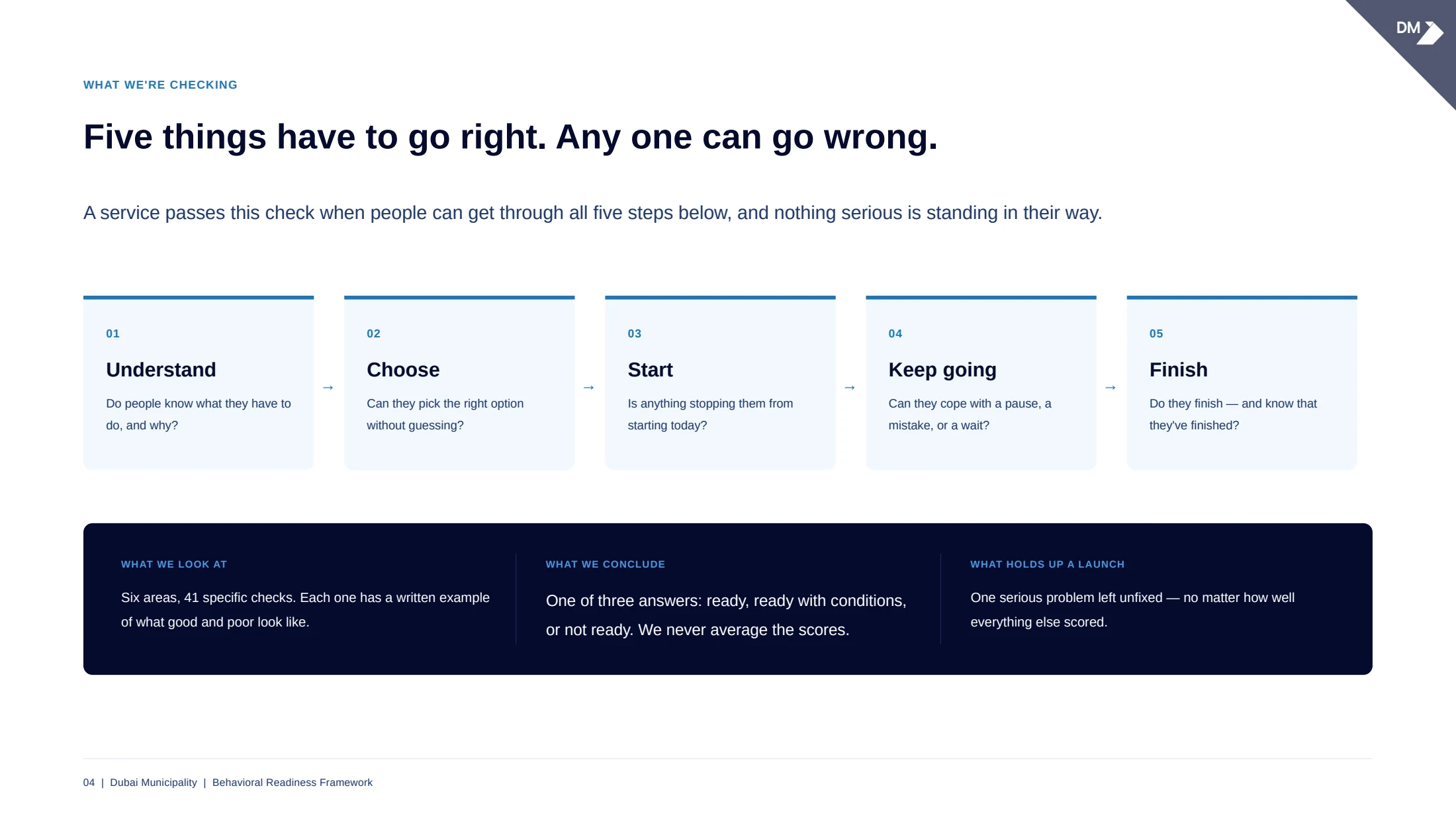
The customer needs to understand, choose, start, continue and finish. The six review areas examine understanding, effort, choices, getting started, completion, and trust or worry.
The reference describes 41 checks with written anchors. Scores distinguish strong evidence, acceptable performance, a failure to meet the check and missing evidence. “Not checked” stays unknown.
A critical barrier cannot disappear into an average
The framework rates issues by who they affect, the consequence, recoverability and frequency. A critical barrier requires a correction and retest; a major issue needs a resolution or an agreed owner, date and monitoring condition.
The resulting decision is ready, ready with conditions or not ready. A senior risk-acceptance decision is recorded separately instead of changing the evidence score.
Fix the service conditions before adding a nudge
The intervention ladder starts with removing an unnecessary step, escalating a problematic rule, reusing known data, moving information and simplifying language or choices. Feedback, access and human support remain part of the response.
A reminder or default needs evidence of the problem, a reason simpler changes are insufficient, preserved entitlements, an explainable customer benefit and measurable stop conditions.
Keep the decision traceable after launch
The twelve-step review covers agreement, evidence gathering, issue assessment, the readiness decision, retesting and post-launch monitoring. Changed behaviour can reopen an earlier decision.
The source includes five service-catalogue scenarios and an explicitly illustrative permit example with invented percentages. Those percentages and sample counts are excluded from portfolio outcome claims. A proposed three-service trial and reviewer calibration are the next validation work.
Outcomes and learning
Review areas
Checks in the reference
Readiness decisions
A documented review method with explicit evidence requirements, ethical conditions and decision rules. Service examples explain the method; completed field validation and institutional adoption need separate evidence.
About the evidence
- Original project materials supplied in October 2026. Excerpts are integrated into the project story; targets and concepts are distinguished from released outcomes.