Give the app a defensible purpose
The strategy identifies a channel gap as transactions move elsewhere, a knowledge gap in unofficial support groups, a finite operational capacity and limited visibility of the work customers receive.
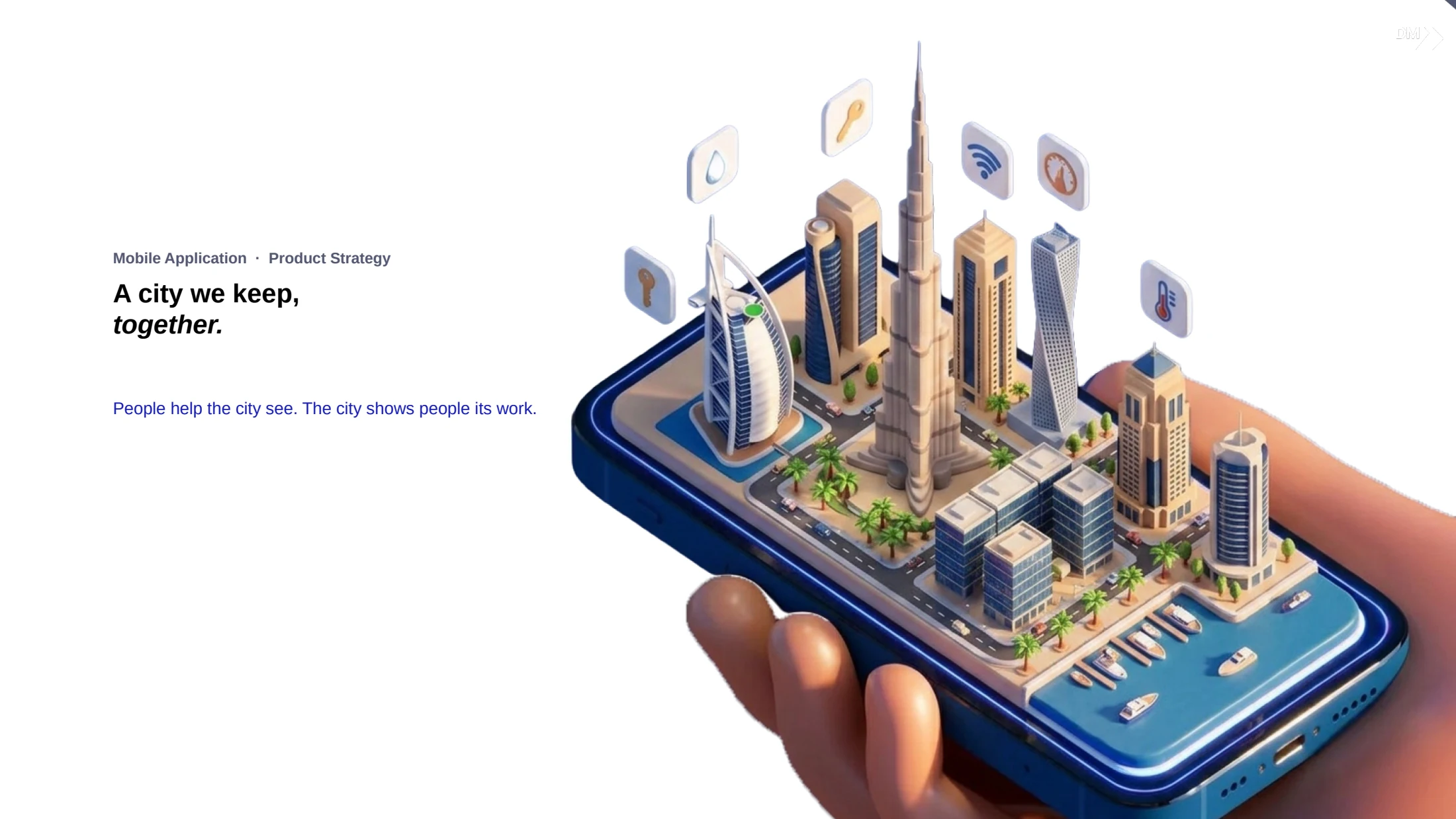
Its product thesis connects the municipality’s physical responsibilities to customer participation. Shared channels retain their established transaction roles; the municipal app concentrates on places, operational evidence and moderated communities.
Four product choices shape the scope
Keep a clear remit
Connect to shared transaction channels. Build the capabilities that depend on municipal crews, assets and expertise.
Start with a place
Organise experiences around a street, park, premises or facility rather than the internal department structure.
Give participation a structure
Use bounded formats, verified answers and named room owners rather than an unrestricted social feed.
Return evidence
Make progress, closure and the result visible to the person who contributed.
Eight components form one service system
The product map has participation, operations and information layers. It connects rooms and support groups, weak signals, incidents, food-safety collaboration, co-creation, recognition, operational services and city information.
The unifying journey is to see, decide, act, prove and recognise. A question becomes reviewed knowledge; an observation becomes a pattern for investigation; a report comes back with a visible outcome.
Make the product proposition tangible
| Scenario | Proposed experience | Delivery dependency |
|---|---|---|
| Professional question | A moderated room with an endorsed answer, source and date | Named experts, bilingual moderation and maintained knowledge |
| Incident report | Photo or voice input, recognised place, status and closure evidence | Asset records, routing, work orders and response expectations |
| Food-safety concern | Private signals inform a reviewed risk picture | Privacy, expert review and municipal enforcement ownership |
| Service delivery | Schedule and evidence attached to the place record | Crew systems, lab records and reliable status data |
| Co-creation | Residents test options before delivery and see what changed | Bounded challenges, research operations and delivery owners |
Prove the loop before expanding it
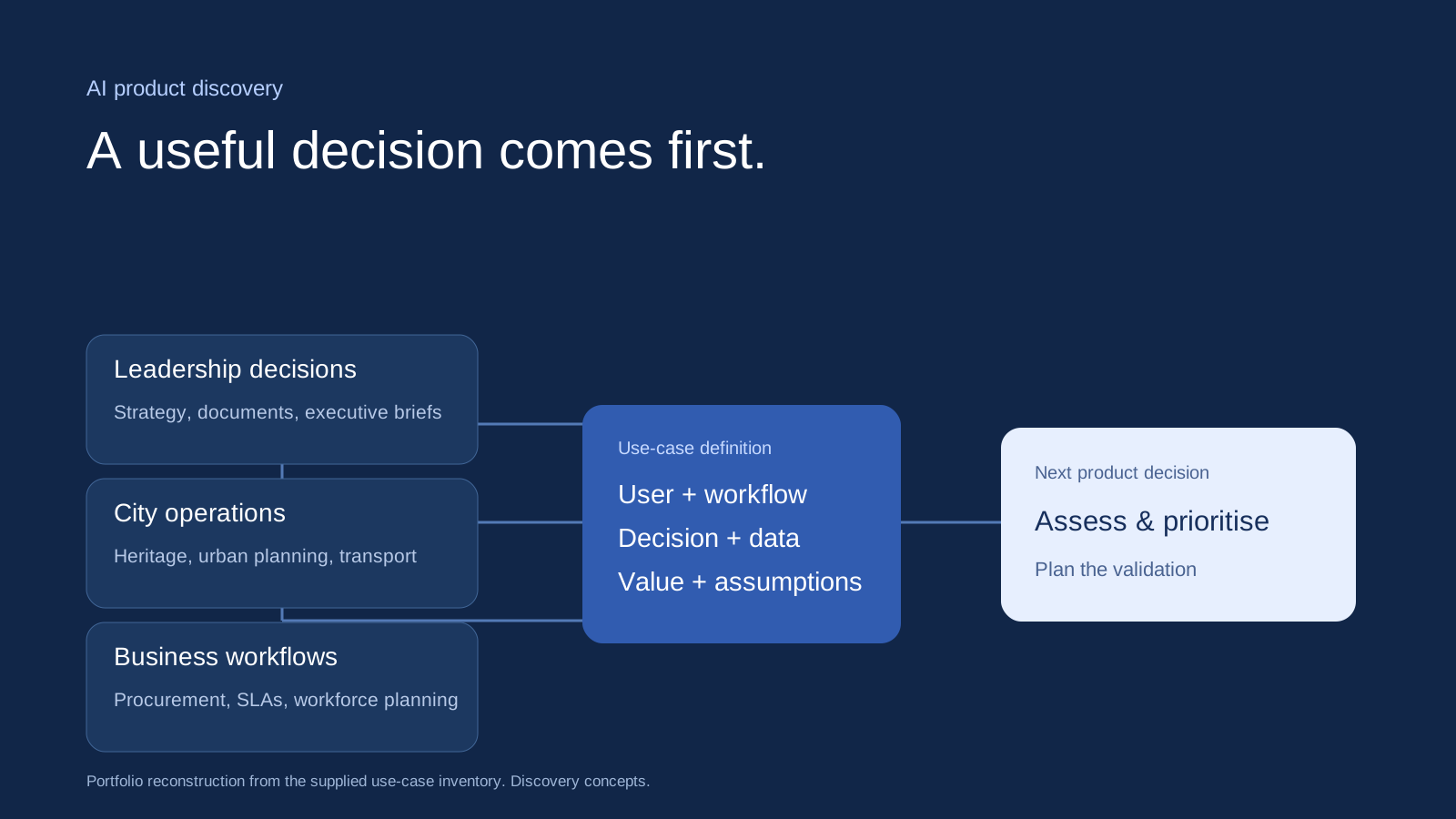
Wave one proposes an engineers’ room, a food-handlers’ room and two neighbourhood rooms. Later waves expand operational services, co-creation and reviewed signal patterns.
Three gates control expansion: rooms demonstrate useful participation, signals produce reviewed action, and completed improvements are published. The roadmap is conditional on that evidence, rather than a calendar of promised features.
Treat ownership and moderation as product requirements
The initial audience is defined through selected professional and neighbourhood communities. Named room owners, response expectations and approved experts make participation credible.
Complaints and formal requests route to the established channels. Food-safety concerns stay private until expert review, and AI-assisted clustering supports reviewers rather than taking enforcement decisions.
The proposal requires a product/design/engineering core, operational owners and bilingual moderation capacity. A clickable pilot and an evidence pack are the next preparation steps in the source.
Count useful improvements, then inspect the whole loop
The proposed north star is improvements triggered by public contributions and published each month. Supporting measures should track returning contributors, reviewed signals, action taken, resolution evidence and avoidable support demand.
Safety measures include moderation workload, handling time, routing errors, privacy incidents and the accessibility of participation. Baselines and achieved results are not supplied.
Outcomes and learning
Components in the proposed product map
Evidence gates before expansion
A documented product thesis, a bounded service model and a roadmap with explicit learning gates. This is strategy work; a live app, launch results and operational savings are not claimed.
About the evidence
- Original project materials supplied in October 2026. Excerpts are integrated into the project story; targets and concepts are distinguished from released outcomes.