The problem: disconnected evidence and decisions
The product definition identifies five recurring organisational gaps rather than starting with a catalogue of AI features.
| Gap in the product definition | Product response |
|---|---|
| Strategy and daily work are disconnected | Trace objectives, initiatives and individual work through a configurable strategy hierarchy. |
| Different functions see fragments of the same problem | Connect service signals, operational issues, quality findings and risk records. |
| Reporting is repeatedly assembled by hand | Create reviewable reporting workflows from an agreed evidence base. |
| Problems are detected late | Define early-warning use cases with a clear operational owner. |
| Risk and readiness are difficult to see | Make review queues, risk indicators and continuity gaps visible. |
These are product hypotheses and demonstration scenarios. They do not establish the prevalence of these problems in a particular client organisation.
Enterprise product definition v2.0; business module map.
Different users need different decisions
| User group | Decision or task | Relevant product surface |
|---|---|---|
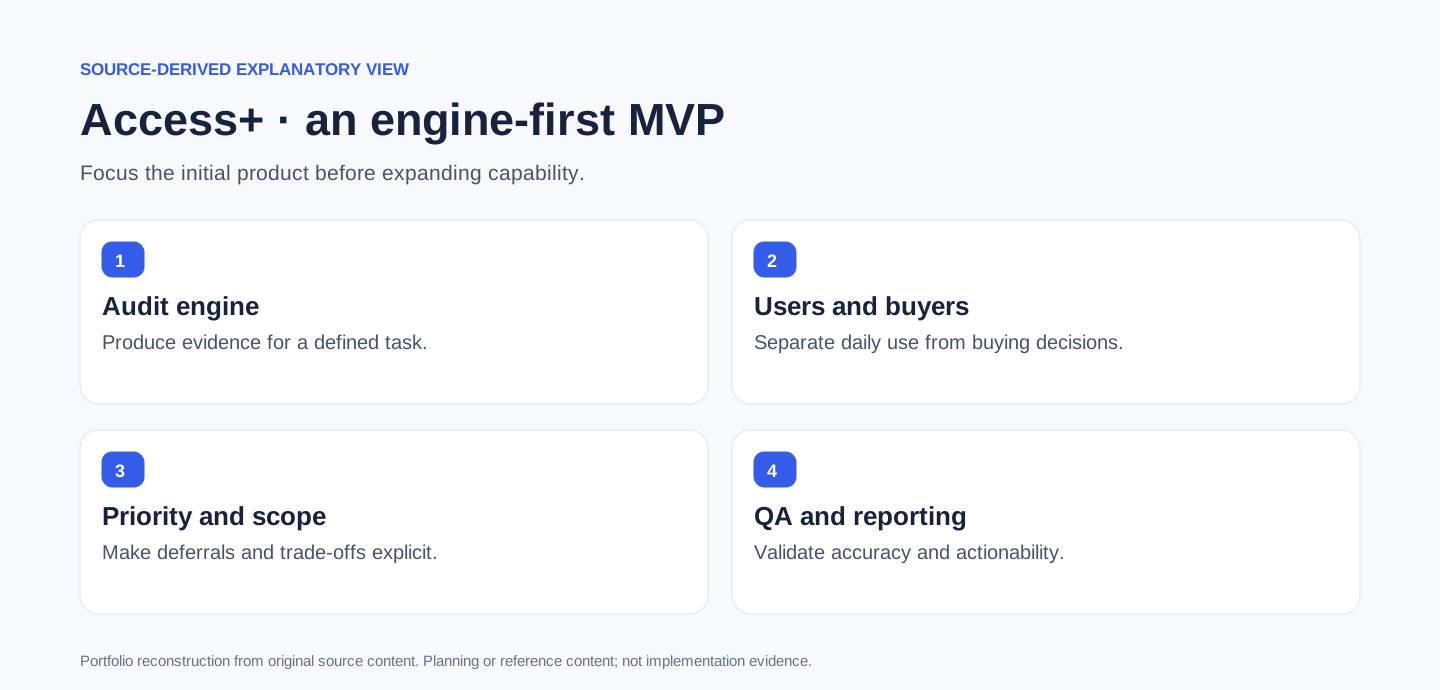
| Leadership | Understand priorities, risks and organisational alignment | Executive command view and decision dossiers. |
| Strategy and performance teams | Connect objectives, KPIs and initiatives | Strategy cascade, scorecards and initiative lifecycle. |
| Department heads | Run a function and understand dependencies | Department workspaces and operational review queues. |
| Employees and reviewers | Act on a task with the right context | Task workspace, draft reports and approval controls. |
Enterprise product definition: target users and product pillars.
The strategic choice: connect systems of record
The concept positions the product above existing ERP, CRM, HR and service systems as an evidence and coordination layer. Replacing those systems is outside the proposed product boundary.
The demonstration combines strategy, operations and intelligence. The product definition distinguishes that vision from the smaller delivery path: real connectors, a real AI service, configurable frameworks and rollout by function.
| Choice | Reasoning | What must be tested |
|---|---|---|
| Connect existing systems rather than replace them | Preserve operational ownership while linking evidence across functions. | Connector feasibility, permissions and source-data consistency. |
| Use one shared organisational model | Allow objectives, tasks and signals to refer to the same context. | Taxonomy fit and the effort needed to maintain it. |
| Start with a focused function or workflow | Reduce delivery scope and make the value testable. | User adoption, review effort and measurable task improvement. |
The staged rollout is a proposed product direction; it is not a record of client implementation.
Enterprise product definition: category, pillars and maturity.
From use-case inventory to a specific workflow
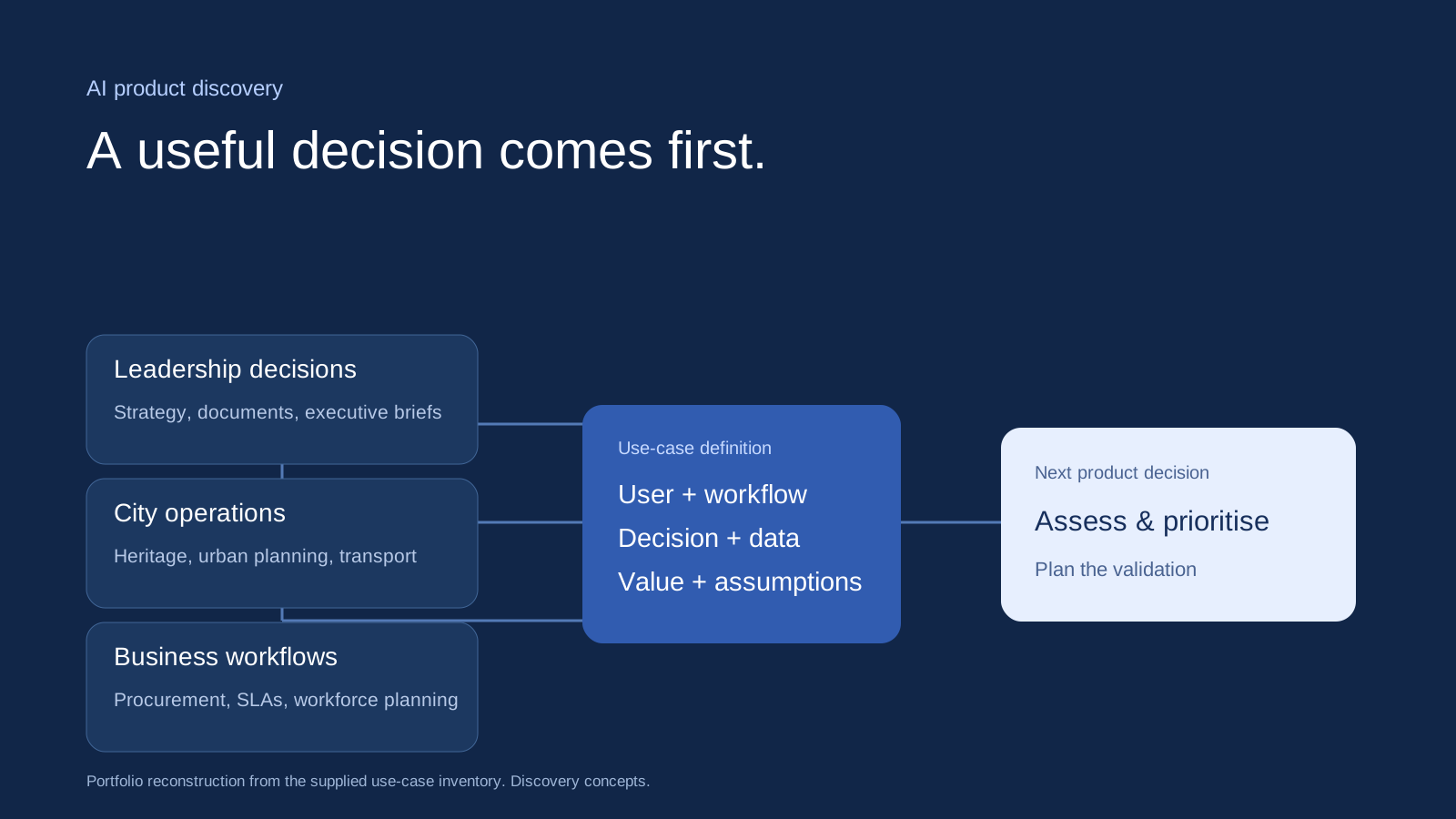
The supplied inventory includes opportunities across strategy, customer service, procurement, capacity planning and spatial work. These examples show the level of definition that makes an idea assessable.
| Opportunity | Input and proposed work | Human checkpoint |
|---|---|---|
| Service-intake copilot | Capture a customer issue from chat or voice; structure fields and check completeness. | Agent or customer confirms the key details before submission. |
| Tender and SLA monitoring | Track tender progress, flag delay risk and draft clarifications. | Procurement reviews recommendations and owns the action. |
| Workforce planning | Use departmental plans and fleet expansion to propose role and capacity needs. | HR and the responsible department review the plan. |
| Transportation demand planning | Relate requests to utilisation and available assets. | Operational staff validate the recommended allocation. |
| Heritage information view | Bring GIS, historical permits and restoration records into one plot context. | Domain specialists interpret the information. |
| Risk and audit support | Standardise findings, identify possible risks and monitor remediation. | Risk owners and auditors review ratings and closure decisions. |
Inventory status such as “Active” denotes an entry status. It is not proof of a production AI deployment.
Supplied AI use-case inventory; product-definition review controls.
Review and accountability belong in the product
Surface the context
Identify the decision, the source information and the responsible function.
Output: A bounded use case with a defined owner.
Generate a proposal
The concept uses assistants and agents to produce drafts, alerts or recommendations.
Output: A reviewable suggestion rather than an unexplained final action.
Approve, reject or revise
The product vision includes human review queues and approval controls for consequential actions.
Output: An accountable decision made by a person.
Keep the decision connected to the work
Initiative records include rationale, alternatives and risk logs; the shared model links the decision to execution.
Output: A traceable governance record.
These controls are defined in the product concept. Their operational effectiveness has not been demonstrated in a live deployment.
Product pillars: humans in charge; initiative lifecycle and agent-orchestrator concepts.
What the demonstration established
The product definition documents a high-fidelity, navigable demonstration across strategy, customer experience, quality, transport, risk and marketing. It makes the product vision tangible enough for scope and stakeholder review.
The module map records the maturity limits: demonstration data, simulated AI, repeated generic department views and incomplete screens. The same evidence prevents a prototype from being presented as a working enterprise platform.
| Established by the artifacts | Still required for implementation |
|---|---|
| A connected product concept and interface architecture | Real source integrations and a maintained data model. |
| Review queues and governance interactions | Enforced identity, permissions, approval and audit controls. |
| A scripted example of cross-function diagnosis | Validation on real operational evidence. |
| Defined department workflows and report concepts | A functioning AI layer, evaluation and user acceptance. |
Product definition: current maturity; business module map: build status and gaps.
How I would make a pilot decision-ready
A proposed validation approach for these opportunities is to choose one frequent task and compare the reviewed output with the current process.
| Question to validate | Evidence to collect |
|---|---|
| Does the workflow solve a useful problem? | Task frequency, current cycle time, rework and user interviews. |
| Is the source information fit for the task? | Coverage, completeness, freshness and permitted access. |
| Can reviewers rely on the output? | Errors, reviewer corrections, accepted recommendations and exception cases. |
| Is the economics case credible? | Implementation cost, ongoing review effort and evidenced time saved. |
| Should the pilot expand? | Sustained use, quality and operational ownership. |
This is a proposed evaluation plan. No accuracy, productivity saving, ROI or adoption result is claimed.
Portfolio interpretation of the product concept and documented maturity limits.
Key screens & project artifacts
Outcomes and learning
Operational opportunities made concrete
Connected strategy, operations and intelligence
Human checkpoints specified in the vision
The evidence establishes concept definition, use-case creation and a high-fidelity demonstration. It does not establish a working AI platform, model accuracy, client adoption or realised business savings.
AI becomes a product opportunity when the value is specific and the assumptions are visible.
About the evidence
- Product definition, demonstration inventory, business-module map and AI-use-case source inventory.
- The prototype uses demonstration data and simulated AI. It is not presented as a working customer deployment or measured ROI.