A financially important journey, at app scale
The engagement covered iOS and Android experiences serving more than 500,000 users. I worked as a Senior CX Consultant on a remote, part-time contract.
My contribution connected the experience strategy to onboarding, lending journeys, customer co-creation, iterative prototypes and developer collaboration. I also presented the direction to C-level executives.
Confirmed career profile: Emkan engagement.
Research and iteration informed the relaunch
Understand the customer experience
The career record documents customer research and co-creation as inputs to the experience strategy.
Output: Experience direction for onboarding and lending.
Make the journey reviewable
Iterative prototypes translated the direction into interactions that customers and stakeholders could evaluate.
Output: Refined prototypes and a coherent native-app experience.
Test and measure
Usability testing and A/B testing are recorded alongside the measurement framework.
Output: A way to assess the experience rather than relying only on visual preference.
Carry the design through implementation
Developer collaboration and design handoffs connected the experience work to the relaunch.
Output: Specifications and reusable design-system support.
The recovered artifacts do not include participant counts, experiment designs or research transcripts. No interview quote or test-result detail is invented.
Career profile: research, co-creation, prototyping, testing and implementation.
Make product choice visible before application
The financing-calculator design shows how an abstract lending proposition becomes a concrete interaction.
| Design detail visible in the artifact | Experience purpose |
|---|---|
| Product options with eligibility labels | Help the customer distinguish available financing products. |
| Monthly instalment and rate display | Place the consequence of a financing choice near the inputs. |
| Salary, tenure and age with sliders and editable values | Allow exploration while retaining a precise value entry. |
| Sector, existing instalments and bank-relationship questions | Expose the information needed by the proposed calculation. |
| Calculate, reset and application actions | Support adjustment and an understandable next step. |
This is an archived design with prototype values. Its eligibility states and financial figures are not lending advice, approved policy or evidence of a working calculation engine.
Emkan Figma financing-calculator frame.
Orientation, verification and recovery are one service
The original interface file makes several consequential moments visible beyond the first onboarding screen.
Orient before registration
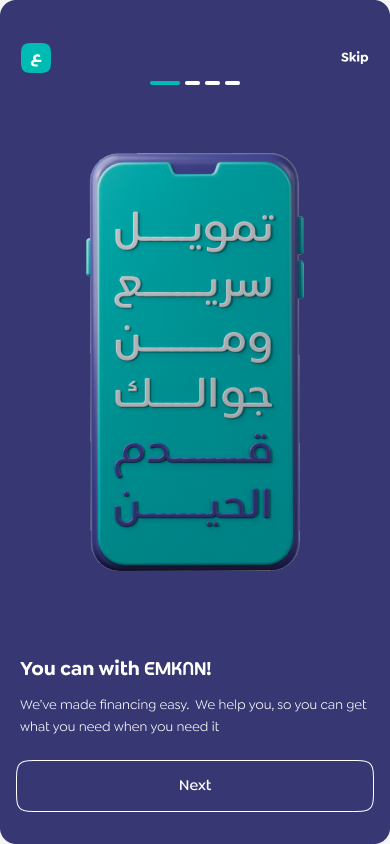
Arabic/English language choice leads to a skippable introduction. The screens connect financing with education, home and personal needs, then offer a clear start action.
Output: A chosen language and an understandable product proposition.
Separate contact and identity verification
Registration includes distinct mobile-code and Absher verification states. The Absher step explains the purpose of the code and exposes confirm and resend actions.
Output: A visible identity step with a retry route.
Explain a blocked sign-in
The account-lock state gives a reason for the block and offers Reset Password or Cancel. Related states in the file cover password and mobile-number updates with success feedback.
Output: A recovery action rather than an unexplained failure.
These are archived interface states with empty or placeholder values. They establish design intent, not implementation, current security policy or verified conversion improvement.
Original Emkan registration, login and onboarding interface file.
A reusable design system supported delivery
I established the measurement framework and design system alongside the relaunch work. Reusable components and implementation collaboration connected consistency in the interface to consistency in delivery.
The reported development-time reduction belongs to the wider team’s design-system work. The available record does not establish a component count, governance cadence or a measured reduction for an individual component.
| Responsibility | How it connects to the product |
|---|---|
| Experience strategy | Sets the direction for onboarding and lending. |
| Prototypes and co-creation | Make the intended experience tangible before handoff. |
| Design system | Supports consistency and reuse across the native app. |
| Developer collaboration | Carries the interaction detail into implementation. |
| Measurement framework | Connects the relaunch to app and usage results. |
Career profile: design system, measurement and handoffs.
Results need contribution and measurement context
| Reported result | What it indicates | Evidence limit |
|---|---|---|
| App rating: 2.7 to 4.3 | A stronger reported customer perception after the relaunch. | Rating window and store-level breakdown were not supplied. |
| Daily active users: +45% | Reported growth in everyday app usage. | The calculation period and baseline were not supplied. |
| Development time: −35% | Reported delivery benefit associated with design-system work. | Measurement method and work-item comparison were not supplied. |
These are engagement results reported in the career record. They are team outcomes; the evidence does not isolate the causal effect of a single design change.
Confirmed career profile and supplied CVs.
Key screens & project artifacts
Outcomes and learning
App-store rating after the relaunch
Reported increase in daily active users
Reported development-time reduction
These results are reported in my career record for the engagement. The measurement windows and calculation methods are not included in the available artifacts. They represent the broader team’s product results, with my contribution in CX strategy, journeys and the design system.
An experience becomes stronger when research, interface craft and delivery consistency reinforce each other.
About the evidence
- Supplied career profile and CVs: role, scope, methods and reported team outcomes.
- Emkan onboarding and financing-calculator frames: archived interface artifacts.
- Additional original interface states: onboarding orientation, Absher verification and account-lock recovery.